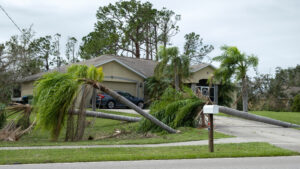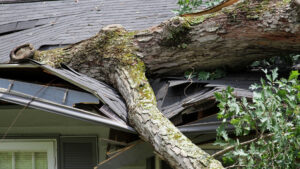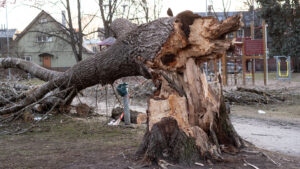
When the National Hurricane Center starts tracking a storm toward Florida, most homeowners think about shutters, generators, and supplies. Far fewer stop to look up at the trees standing over their roof, their driveway, and their power lines. Yet trees cause a huge share of the damage in every hurricane that crosses the state, from Hurricane Andrew in 1992 to Hurricane Ian in 2022. Falling trunks crush homes and cars, snapped limbs become projectiles, and uprooted root plates tear up foundations and water lines.
Here is the part most people miss: trees rarely fail without warning. Research from the University of Florida IFAS Extension after major storms shows that the trees most likely to come down were usually compromised long before the wind arrived. The signs were there. People just did not know what to look for.
At Jireh Tree Care, we inspect trees across Florida every storm season, and the same five warning signs come up again and again. Walk your property and check your trees against this list before the next storm forms in the Atlantic.
1. A New or Worsening Lean
Not every leaning tree is dangerous. Some trees grow at an angle their entire lives, reaching for sunlight, and remain perfectly stable. The danger sign is change. A tree that used to stand straight and now leans, or a lean that has gotten noticeably worse, means the root system is losing its grip on the soil.
In Florida this is especially serious because our sandy soils give roots less to hold onto than the clay soils found further north. Look at the ground on the side opposite the lean. If you see soil mounding, cracking, or lifting, the root plate is starting to rotate out of the ground. A tree in that condition can fail in winds far below hurricane strength, and in a real storm it is one of the most likely trees on your street to come down. This is a call-the-professionals-now situation, not a wait-and-see one.
2. Mushrooms or Fungal Growth at the Base
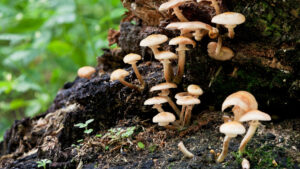
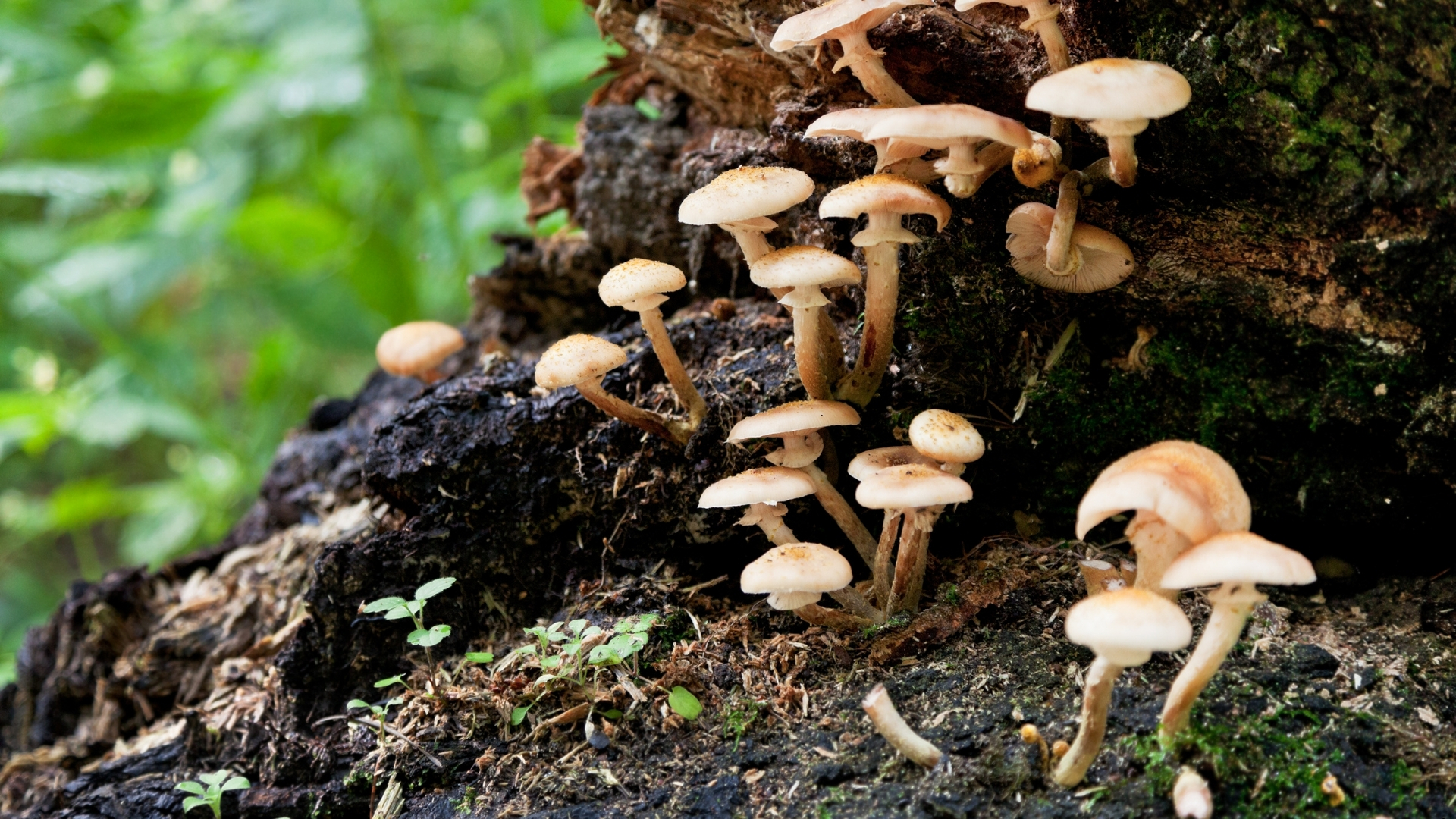
Fungus growing on or around a tree is more than a cosmetic issue. Mushrooms, conks, or shelf-like brackets at the base of the trunk or on surface roots usually mean one thing: decay is eating the wood from the inside. By the time fruiting bodies appear on the outside, the rot inside is often well advanced.
Root rot is particularly dangerous because it destroys the very system that anchors the tree, and it does so invisibly. A tree with significant root decay can have a full, green, healthy looking canopy right up until the moment a hurricane pushes it over. Ganoderma, a fungus common throughout Florida, is a frequent killer of palms and hardwoods alike and has no cure. If you see mushroom growth at the base of any large tree near your home, have it evaluated by a professional before storm season.
3. Cracks, Cavities, and Hollow Spots in the Trunk
The trunk is the structural backbone of the tree, and visible defects there deserve immediate attention. Vertical cracks, especially deep ones or ones that run through the bark into the wood, show the trunk is already failing under its own load. Hurricane force winds multiply that load many times over.
Cavities and hollows are also red flags. They often form where a branch broke off years ago and decay moved in. A small cavity in a huge, otherwise healthy trunk may be manageable, but a large hollow means the tree has lost much of the solid wood it needs to resist bending forces. Tap-test folklore aside, only a proper inspection can tell how much sound wood remains. If you can see daylight through part of a trunk, or a cavity is big enough to put your arm into, treat that tree as a serious storm hazard.
4. Dead Wood and Hanging Branches in the Canopy
Look up into the canopy. Dead branches are easy to spot in a Florida landscape because they hold no leaves while everything around them stays green year round. Hanging or partially broken limbs, sometimes called widow makers for good reason, are even more urgent.
In a hurricane, dead wood is the first thing to go, and a branch does not need to be large to be destructive at 100 miles per hour. Dead limbs shatter windows, punch holes in roofs, and take down power lines, turning one tree problem into a neighborhood wide outage. Heavy deadwood throughout a canopy also signals a deeper problem, since healthy trees do not die back section by section without a cause such as disease, root damage, or pest infestation. Removing deadwood is one of the most cost effective storm preparations there is, but it belongs to a professional crew, not a homeowner on a ladder.
5. Weak Branch Unions and Co-Dominant Stems
This is the warning sign most homeowners have never heard of, and it is one of the most common causes of failure in species like laurel oak and water oak. Look at where major limbs meet the trunk. A strong union forms a wide, U shaped angle. A weak union forms a tight, V shaped fork where two stems of similar size grow from the same point, often with bark pinched between them.
That pinched bark, known as included bark, prevents the wood from fusing properly. The result is a joint that looks solid but is essentially two trees leaning against each other. In hurricane winds these unions split apart, sending half the tree onto whatever sits below. Trees with co-dominant stems can often be saved with structural pruning or cabling if the problem is caught early, which is exactly why a pre season inspection pays for itself.
See Any of These Signs? Act Before the Storm Does
One warning sign is a reason for an inspection. Two or more on the same tree is a reason to act quickly, especially if that tree stands within falling distance of your home, your neighbor’s property, or power lines. The Atlantic hurricane season runs from June 1 through November 30, and the best time to deal with a hazardous tree is a calm day of your choosing, not the chaotic days after a storm when every tree service in Florida is overwhelmed.
A professional evaluation takes the guesswork out of the decision. Crews working alongside an ISA Certified Arborist, credentialed by the International Society of Arboriculture, can determine whether a tree needs selective pruning, structural support, or removal, and then do the work safely with the right equipment.
Jireh Tree Care serves homeowners across Florida, from the South Florida coast to communities throughout the state. If any tree on your property is showing these warning signs, contact us today to schedule an inspection. Spotting the problem now costs you a phone call. Ignoring it could cost you your roof.